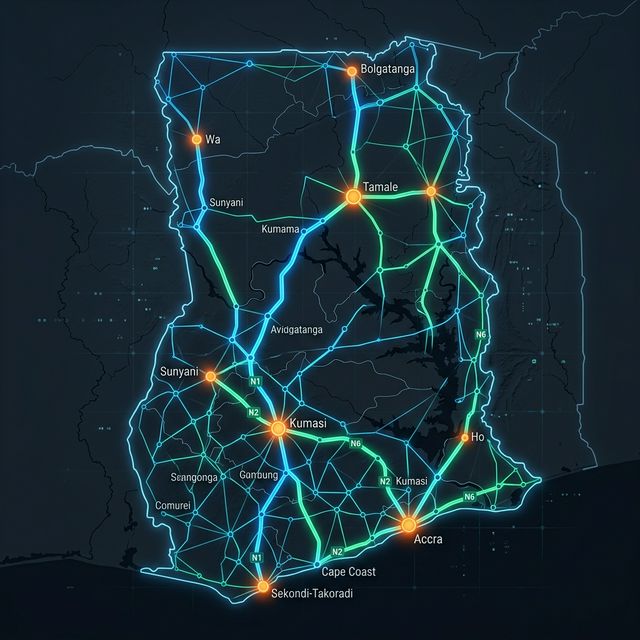
Ghana Road Transport Network
01. Overview
A full-stack solution to the Ghana Road Transport Network Programming Challenge 2026 at Ashesi University. Models Ghana's intercity road network as a graph, implements Dijkstra, Yen's K-Shortest Paths, and cost analysis - exposed via a Java CLI, a Spring Boot REST API, and an interactive Next.js web frontend.
The Objective
To model Ghana's intercity road network as a graph and provide tools to explore routes, estimate costs, and manage road connectivity through a CLI, REST API, and interactive web interface.
The Outcome
A production-grade multi-layer system handling all 10 challenge questions, with an interactive force-directed graph visualization, route exploration, real-time edge editing, and cost recommendation engine.
02. Stack Architecture
03. Key Features
Dijkstra shortest distance and fastest time path (Q4, Q5)
Yen's Top-3 K-Shortest loopless paths (Q6)
Fuel and time cost recommendation engine (Q7, Q8)
Interactive CLI session with multi-query support (Q9)
Time complexity analysis scaling from 100 to 5,000 nodes (Q10)
Force-directed interactive network graph with route highlights
Real-time road editing (add, update, remove) from the browser
04. Engineering Pipeline
Parsed 557-entry road dataset, deduplicating to clean bidirectional edge set
Built CLI answering all 10 challenge questions (Q1–Q10) via terminal
Wrapped the same Java logic in a Spring Boot REST API (Q1–Q10 endpoints)
Built an interactive Next.js frontend with force-directed graph visualization
Added interactive edge editing (add, update, delete) through the frontend
05. Challenges & Execution
The Constraint
6 duplicate bidirectional edges with conflicting weights in the raw dataset
The Execution
Used a LinkedHashMap with case-insensitive town keys; addEdge silently overwrites duplicates to ensure a clean, deterministic graph.
The Constraint
Efficiently finding top-K loopless shortest paths without modifying the main graph
The Execution
Implemented Yen's K-Shortest Paths algorithm with a temporary EdgeRemover to spur-path-explore without permanently mutating the graph.
The Constraint
Bridging a Java backend and a Next.js frontend with CORS and shared state
The Execution
Configured Spring Boot CORS to allow localhost:3000 and designed a singleton graph bean shared across all API controllers.