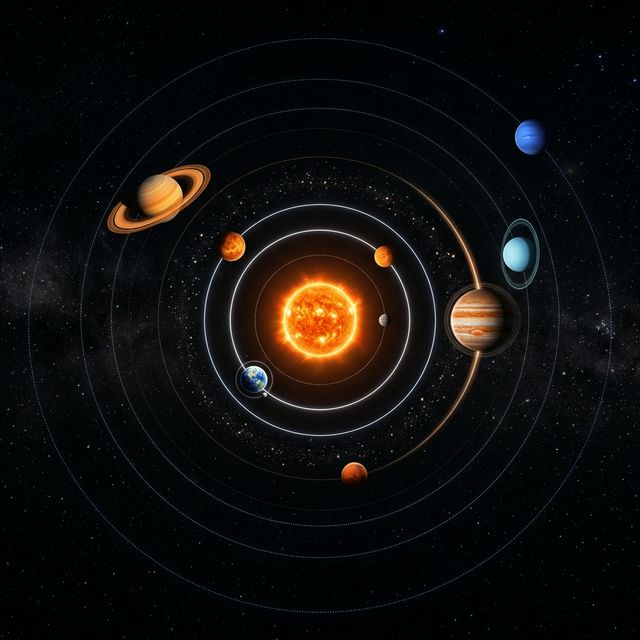
Solar System Simulation
01. Overview
A Python-based solar system simulation using Pygame for real-time visualization of planetary orbital mechanics, gravitational interactions, and celestial physics - including accurate Newton's law computations, orbital velocity, escape velocity, and data export to CSV.
The Objective
To build an educational tool that provides an interactive and physically accurate simulation of the solar system, enabling exploration of orbital mechanics and gravitational dynamics.
The Outcome
A fully functional Pygame simulation with real-time planetary rendering, physics-based gravitational interactions, moon support, logging, and CSV data export.
02. Stack Architecture
03. Key Features
Real-time gravitational force simulation between all bodies
Accurate orbital velocity and period calculations (Kepler's 3rd Law)
Moon and Star object support
Escape velocity, surface gravity, and orbital period per planet
CSV data export for all computed attributes
Dynamic logging and error handling
04. Engineering Pipeline
Designed Planet, Sun, Moon, and Star classes with full physics method suites
Loaded planet data dynamically from a structured CSV file
Added logging decorators to track function entry/exit and execution time
Built a CSV export feature to record computed planetary attributes
05. Challenges & Execution
The Constraint
Accurately simulating gravitational attraction between all planet pairs in real time
The Execution
Implemented Newton's law of universal gravitation with full force decomposition using atan2.
The Constraint
Decomposing force vectors into x/y components for multi-body orbital paths
The Execution
Optimized the simulation loop to iterate over all planet pairs efficiently using list comprehension.
The Constraint
Maintaining simulation stability across large time step variations
The Execution
Added a configurable time-step parameter so users can slow down or speed up the simulation.